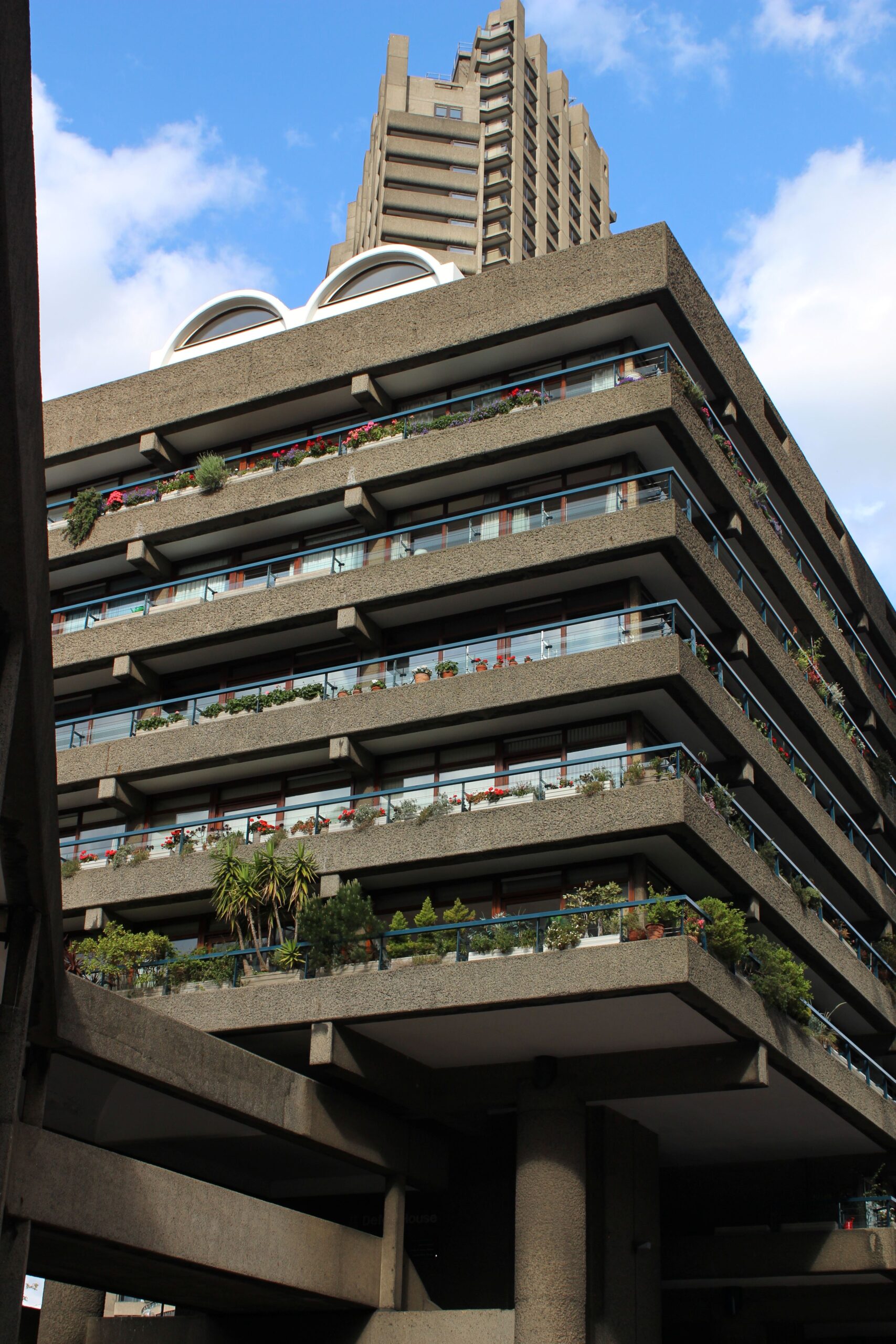

The recent movie The Brutalist has put brutalist architecture ‒ which showcases bare, rough building materials, and focuses on structural rather than decorative elements ‒ under the spotlight.
How timely and thoughtful, then, that on a visit to London, my architect son-in-law planned a tour of the Barbican, a prime example of Brutalist architecture.
This style emerged in post-war Britain in the 1950s, centred on the concept that buildings should be “honest”, hiding neither their materials, nor how they are put together.
The Barbican was designed by the architectural firm Chamberlin, Powell and Bon. They had first come into the public eye when they designed the nearby Golden Lane Estate, a 1950s council housing complex in the City of London. All three lectured in architecture at the Kingston School of Art, and had agreed that if any of their separate entries won, they’d share the commission as a team. Powell won, paving the way.
The trio initially envisaged that the Barbican would sport terrace blocks covered with white marble, towers coated with highly polished concrete, and columns finished in smooth, coloured concrete. The balconies were to be surfaced with mosaic tiles. The City of London ‒ unsurprisingly ‒ decided this was too expensive, and so they went for a hand-hammered, labour-intensive concrete finish instead.
While Golden Lane was built as social housing, the architects now had well-travelled young professionals in mind, “likely to have a taste for Mediterranean holidays, French food and Scandinavian design.”
The Barbican Estate is now home to over 4,000 residents, living in more than 2,000 small flats, many sporting flower-filled window boxes whose bright colours stand out against the grey exteriors. While the Estate owner, the City of London Corporation, initially let flats at market rates, most are now privately owned.
You can’t access most of the best areas as a visitor because they are resident-only, but you can explore the convoluted walkways and stride up the ramps between various levels. As you cross between the buildings on a vast pedestrian bridge, you gaze down on the lake with its waterfalls, fountains, and green plantings.
Apparently, the extremely shallow lake water is dyed to reflect the tall grey buildings. (The Circle underground line lies directly underneath the lake, so it couldn’t be dug any deeper.)
Besides housing, the estate includes the Barbican Centre, a fabulous arts venue, and other amenities like the Guildhall School of Music & Drama, art galleries, movie houses, a concert hall and theatres.
The London Symphony is the resident orchestra and, after drinks from the Barbican Kitchen, what a treat to hear works by Strauss and Mozart, with Georgian-born Berlin-based violinist Lisa Batiashvili, conducted by Sir Antonio Pappano.
The Centre may have been voted “London’s ugliest building” in 2003, but it’s stood the test of time and is well worth exploring.
Location: Level G, Barbican Centre, Silk Street, London EC2Y 8DS. The Barbican is accessible by bus, tube, train, on foot or bicycle. Plan your journey and find more route information in ‘Your Visit’.
Find out more: https://www.barbican.org.uk/
© Images and content Judy Bryant